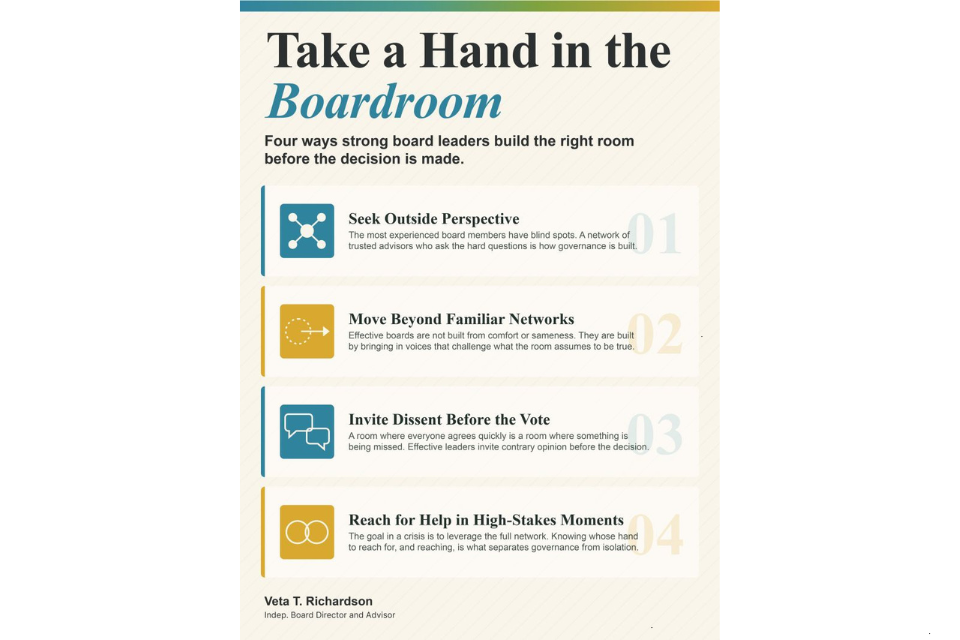
The leaders who govern best are rarely the ones with all the answers.
A board that reaches consensus quickly without challenge may be moving fast toward the wrong conclusion. The most effective board leaders I have worked with understand this, and they actively invite differing views rather than manage around them. Yet at the same time, they do not express differing views just to hear themselves speak.
They seek out the voice in the room that is willing to say what others may not yet have considered. Appropriately expressed dissent adds value to the discussion of any issue, and the absence of it should concern every board leader.
One of the most powerful stories shared with me as I’ve explored this topic came from a new board member who sat through several sessions feeling too intimidated to raise an oversight she had observed. When she finally spoke, there was stunned silence. The rest of the board had completely missed what she identified. That comment changed the direction of a major decision.
Take a Hand is the fourth habit in my book, Take Six, and it is one of the most important for board leaders to internalize.
In the boardroom, that means knowing when to reach beyond familiar networks, siloed expertise, and comfortable agreement.
Strong boards are built by bringing in people who ask harder questions and expand the board’s ability to govern with clarity.
Diverse voices at the table reveal blind spots that a narrow circle will consistently miss. Building that kind of board takes intentional effort, and it begins with the willingness to invite challenge before the vote is called.
What would change if every board leader knew when to reach for outside perspective before the vote?
Originally posted in LinkedIn.com
