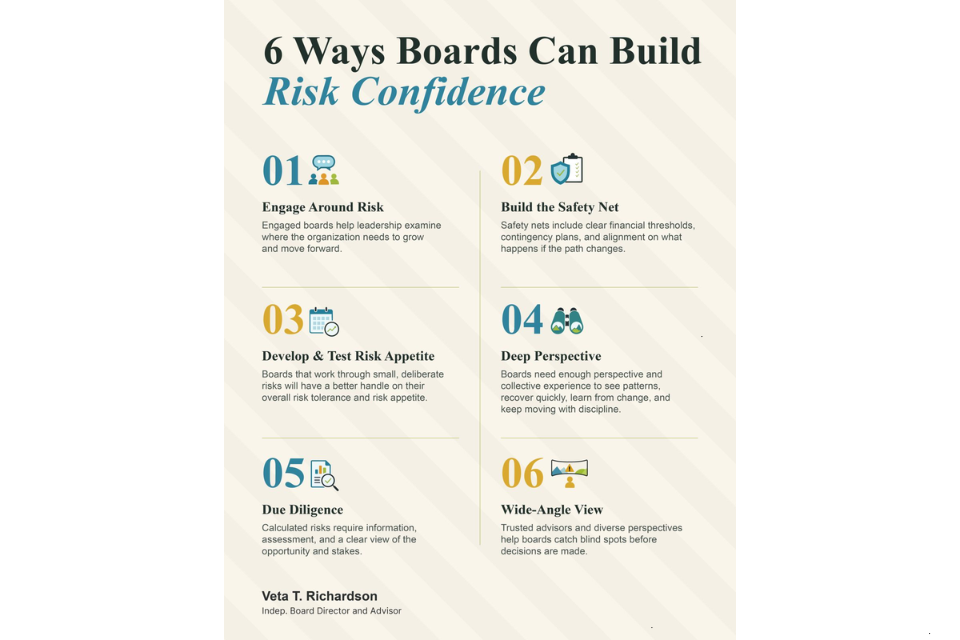
What if the biggest risk to your board right now is playing it too safe? Instead of guarding against disruption, are you missing the chance to potentially be a disruptor who opens new opportunities?
Take Risk is the second principle inside Take Six, and it builds directly on the first.
Before a board can assess risk, it needs an honest picture of where the organization stands today and where it needs to go. That is the work of Take Stock, the first principle, and it is what makes Take Risk possible.
Most boards spend a lot of time thinking about risk mitigation. In fact many boards even form Risk Management Committees and executive teams include Chief Risk Officers. They operate in mostly preventative mode. The concern arises when boards get so good at risk prevention that they lose the ability to examine risk for opportunities.
Risk is a muscle, and it requires practice. Boards that take small, deliberate risks are ready when significant opportunities present. What is your board’s risk tolerance level and is it static or capable of evolving?
When boards understand the stakes, they can chart the path forward. A calculated risk means the opportunity has been examined and the assumptions have been pressure-tested.
Stagnation carries its own risk, and it often goes unexamined. Diverse perspectives help boards catch blind spots before they become costly missteps, but diverse perspectives will also see what might otherwise go overlooked.
When I authored 𝘛𝘢𝘬𝘦 𝘚𝘪𝘹: 𝘌𝘴𝘴𝘦𝘯𝘵𝘪𝘢𝘭 𝘏𝘢𝘣𝘪𝘵𝘴 𝘛𝘰 𝘖𝘸𝘯 𝘠𝘰𝘶𝘳 𝘋𝘦𝘴𝘵𝘪𝘯𝘺, 𝘖𝘷𝘦𝘳𝘤𝘰𝘮𝘦 𝘊𝘩𝘢𝘭𝘭𝘦𝘯𝘨𝘦𝘴, 𝘈𝘯𝘥 𝘜𝘯𝘭𝘰𝘤𝘬 𝘖𝘱𝘱𝘰𝘳𝘵𝘶𝘯𝘪𝘵𝘪𝘦𝘴, I did so intending to offer a career strategies guide.
It was exciting to witness my first book sell out its first print run and become an Amazon best seller in strategic management within four months of its debut.
Now, I’m looking forward to exploring those lessons through a board governance lens and helping leaders apply them with greater intention and impact.
Originally posted in LinkedIn.com
