When everything runs clean (no friction, no debate, every vote passing fast), it’s worth asking: Where did the real conversation happen?
Early consensus-building can be a double-edged sword; meaning that sometimes it’s effective and sometimes it’s not. In some environments, it sharpens thinking and keeps things moving. The risk emerges when decisions are settled before the meeting starts — with agendas functioning as control mechanisms — and the board shifts from evaluating strategy to endorsing it. That’s when shadow governance takes hold.
The most effective boards are intentional about where that line sits. Informal dynamics can support rigorous debate, but it should never replace it.
If the boardroom is not the place where strategy gets debated, and yes, where it is also challenged, governance may have already left the room. The boards that recognize this and take time to assure expediency isn’t mistaken as effective, are the ones leading with clarity and real strategic impact.
Perhaps the question to ask is whether board members are being brought in early enough to contribute to shaping the outcome, or only just in time to approve it?
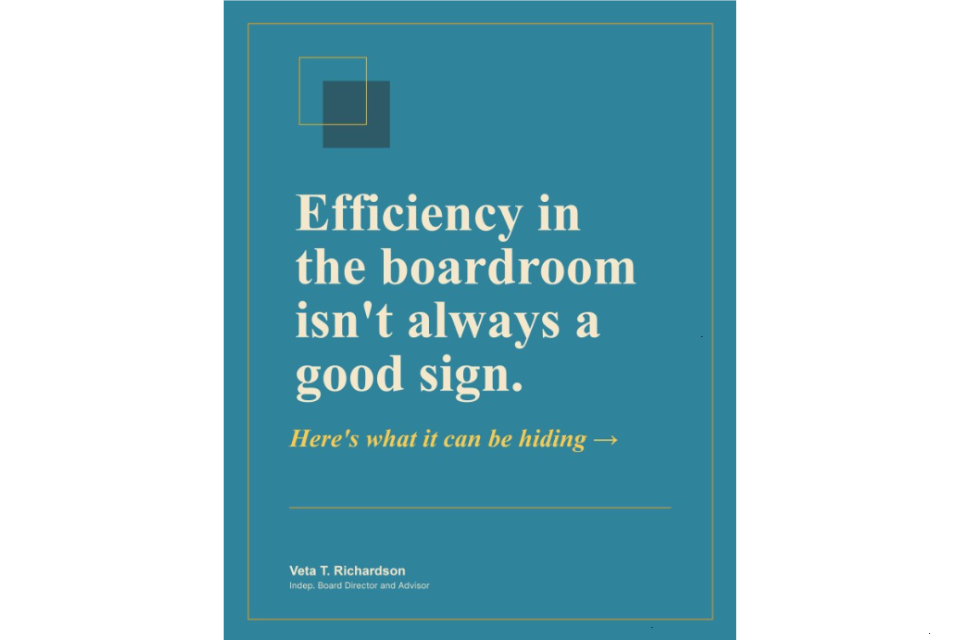

Smooth board meetings can be a red flag.
When everything runs clean (no friction, no debate, every vote passing fast), it’s worth asking: Where did the real conversation happen?
Early consensus-building can be a double-edged sword; meaning that sometimes it’s effective and sometimes it’s not. In some environments, it sharpens thinking and keeps things moving. The risk emerges when decisions are settled before the meeting starts — with agendas functioning as control mechanisms — and the board shifts from evaluating strategy to endorsing it. That’s when shadow governance takes hold.
The most effective boards are intentional about where that line sits. Informal dynamics can support rigorous debate, but it should never replace it.
If the boardroom is not the place where strategy gets debated, and yes, where it is also challenged, governance may have already left the room. The boards that recognize this and take time to assure expediency isn’t mistaken as effective, are the ones leading with clarity and real strategic impact.
Perhaps the question to ask is whether board members are being brought in early enough to contribute to shaping the outcome, or only just in time to approve it?